
When I first joined an LNG carrier, one thing immediately caught my attention.
Unlike conventional oil tankers or chemical tankers, almost every major system onboard existed for one purpose:
Keeping LNG cold.
That sounds simple, but achieving this objective requires one of the most advanced cargo containment systems ever installed on a commercial vessel.
Understanding the cargo system is therefore much more important than memorizing equipment names.
Once you understand the design philosophy, every compressor, cargo pump, valve, and sensor suddenly starts to make sense.
The Cargo Tank Is Not Actually Part of the Ship
One of the biggest misconceptions among cadets is that the cargo tank is welded directly to the ship’s hull.
It is not.
Instead, the cargo containment system is installed inside the inner hull and completely separated from the outer shell.
This separation serves two critical purposes.
First, it safely contains LNG at approximately -163°C.
Second, it protects the ship’s steel structure from extreme cryogenic temperatures that could cause brittle fracture.
The cargo containment system is therefore designed as an independent system supported by insulation rather than by direct contact with the hull structure.
Looking From the Outside to the Inside
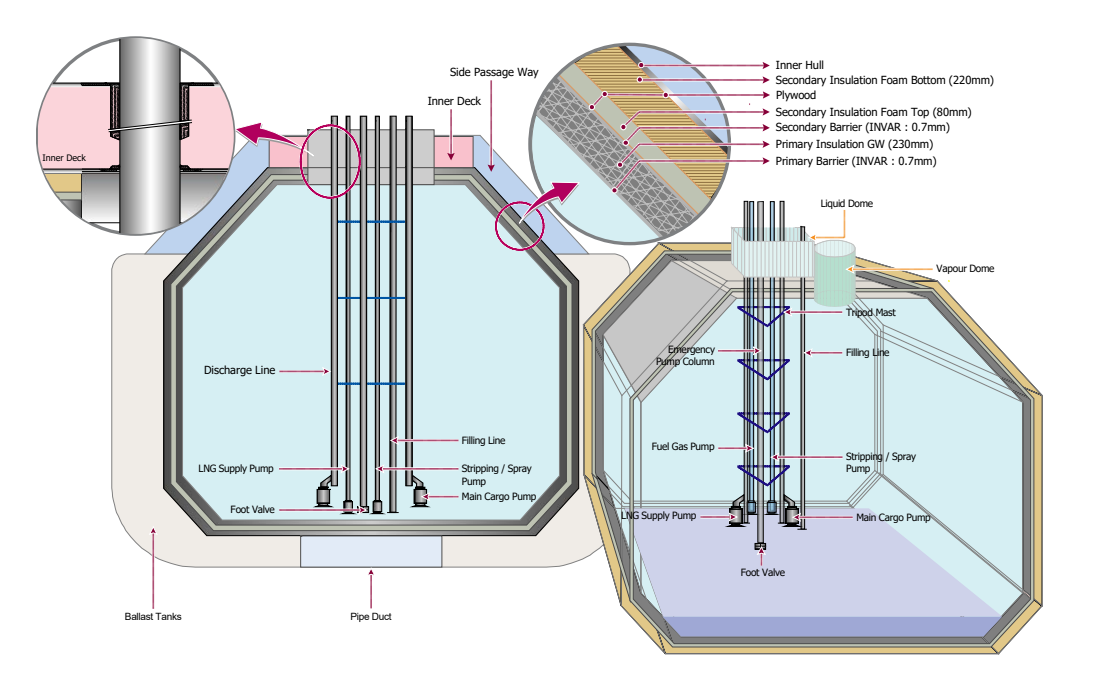
(Insert the cross-sectional drawing here.)
Looking at the drawing from outside to inside, the cargo system consists of several protective layers.
Outer Hull
↓
Water Ballast Tank
↓
Inner Hull
↓
Secondary Insulation Space
↓
Secondary Barrier (INVAR)
↓
Primary Insulation
↓
Primary Barrier (INVAR)
↓
LNG Cargo
This multi-layer arrangement follows a simple engineering principle.
If one layer fails, another independent layer continues protecting both the cargo and the vessel.
Redundancy is the foundation of LNG cargo containment.
Why INVAR Is Used Instead of Ordinary Steel
One question frequently asked by junior engineers is:
“Why don’t we simply build a thicker steel tank?”
The answer lies in thermal expansion.
At cryogenic temperatures, ordinary steel contracts significantly.
Repeated loading and warming cycles would generate excessive stress within the structure.
For this reason, modern membrane LNG carriers use 36% nickel steel (INVAR).
INVAR has an exceptionally low thermal expansion coefficient, allowing the membrane to remain dimensionally stable even at LNG temperatures.
Although the membrane itself is only about 0.7 mm thick, its strength comes from being continuously supported by the insulation boxes behind it.
The membrane is designed to contain liquid.
The insulation is designed to carry the load.
Insulation Is More Important Than Many Engineers Realize
Most people think insulation simply keeps cargo cold.
In reality, insulation is constantly fighting against heat transfer.
Every watt of heat entering the cargo produces Boil-Off Gas (BOG).
More heat means:
- Increased cargo pressure
- Higher compressor load
- More fuel consumption
- Reduced cargo efficiency
For this reason, NO96 cargo tanks use a double insulation arrangement consisting of:
Primary insulation
Secondary insulation
Pressure-controlled nitrogen spaces
Hydrocarbon detection systems
The system is continuously monitored throughout the voyage.
Even a small hydrocarbon concentration inside the insulation space can become an early indication of membrane leakage.
Understanding the Pump Tower
Looking inside the cargo tank, another distinctive feature becomes visible.
The vertical structure located in the center is known as the Pump Tower.
Rather than placing equipment throughout the tank, almost every major cargo operation is concentrated within this single structure.
Typical equipment includes:
- Main Cargo Pumps
- Spray/Stripping Pump
- Fuel Gas Pump
- Filling Line
- Discharge Line
- Vapour Line
This arrangement minimizes the number of penetrations through the cargo containment system while simplifying inspection and maintenance.
Why Ballast Tanks Surround Every Cargo Tank
Many cadets assume ballast tanks exist only for trim and stability.
On LNG carriers, they also provide another critical function.
They physically separate seawater from the cryogenic cargo containment system.
This protective space reduces thermal interaction with the hull and provides additional protection in grounding or collision scenarios.
From a surveyor’s perspective, ballast tanks surrounding cargo tanks deserve particular attention because corrosion, coating breakdown, or structural defects may eventually affect the long-term integrity of the cargo containment system.
The Hidden Systems That Never Sleep
Unlike many mechanical systems that operate only when required, an LNG cargo system is continuously managing heat transfer.
Pressure sensors,
temperature sensors,
nitrogen generators,
gas detection systems,
compressors,
cargo instrumentation,
and Emergency Shutdown (ESD) logic are constantly working together.
Most passengers never notice them.
Most visitors never enter the Cargo Machinery Room.
Yet these systems quietly perform millions of calculations and adjustments throughout every voyage.
The cargo system is not simply transporting LNG.
It is continuously managing energy.
An Engineer’s Perspective
After spending years onboard LNG carriers, I gradually stopped thinking of the cargo tank as a storage space.
Instead, I began thinking of it as a living engineering system.
Every pressure change,
every temperature variation,
every Boil-Off Gas trend,
and every compressor start tells a story about heat transfer occurring inside the cargo containment system.
Understanding those relationships is far more valuable than simply memorizing equipment names.
Final Thoughts
An LNG carrier is essentially a floating cryogenic plant.
Its cargo containment system combines advanced materials, multiple insulation barriers, sophisticated instrumentation, and carefully designed redundancy to transport natural gas safely across the world.
For marine engineers, cadets, and future surveyors, mastering the cargo system is the first step toward understanding every other LNG cargo operation.
