

Introduction
When I first started spending time around welding jobs during dry dockings, I honestly thought stick welding looked pretty simple.
From a distance, it seemed like all you had to do was strike the arc and move the electrode along the joint. But the more repair work I watched, the more I realized that experienced welders spent much more time preparing than actually welding.
What surprised me most was that many welding problems weren’t caused by the welding machine at all.
Instead, they came from small mistakes that almost every beginner makes sooner or later.
Sometimes the arc wouldn’t even start.
Sometimes the electrode kept sticking.
Other times the weld looked fine on the surface but ended up needing to be repaired after inspection.
The good news is that most of these problems are easy to avoid once you understand what causes them.
In this article, I’ll go through ten common arc welding mistakes that I’ve seen beginners make and explain how to avoid them before they become frustrating habits.
Why Beginners Run Into These Problems
One thing I’ve noticed is that beginners usually assume something is wrong with the welding machine.
In reality, that’s rarely the case.
More often than not, the machine is working perfectly.
The real problem is somewhere between the electrode, the ground clamp, and the workpiece.
I’ve watched experienced welders solve what looked like major problems in less than thirty seconds simply because they knew exactly what to check first.
That’s why learning the basics is so important.
Once you understand these common mistakes, troubleshooting becomes much easier
.
Mistake #1 – Holding the Electrode by the Flux Instead of the Metal Core
This sounds like an obvious mistake until you actually see someone do it.
A stick welding electrode has two different parts.
The metal rod carries electricity.
The outer coating, known as the flux, creates shielding gas and slag while welding.
If the holder grips only the flux coating instead of the exposed metal rod, electricity can’t flow properly.
No current means no arc.
I’ve actually watched people spend several minutes adjusting the machine settings before realizing the electrode wasn’t making proper electrical contact.
It’s one of those problems that’s frustrating because the solution is incredibly simple.
Before assuming something is wrong with the machine, always check how the electrode is installed in the holder.
Sometimes that’s all it takes.
Mistake #2 – Using the Ground Clamp Like an Electrode Holder
I remember laughing the first time I heard someone mention this mistake because I thought nobody would actually do it.
Then I saw a beginner trying exactly that.
The ground clamp and the electrode holder can look surprisingly similar if you’ve never used a welding machine before.
Some beginners accidentally try to hold the electrode with the ground clamp instead of the electrode holder.
Of course, the electrode doesn’t stay in place, and welding can’t even begin.
Once someone explains the difference, it seems obvious.
The electrode holder supplies current to the electrode.
The ground clamp completes the electrical circuit through the workpiece.
Both are important.
They just have completely different jobs.
📷 Photo
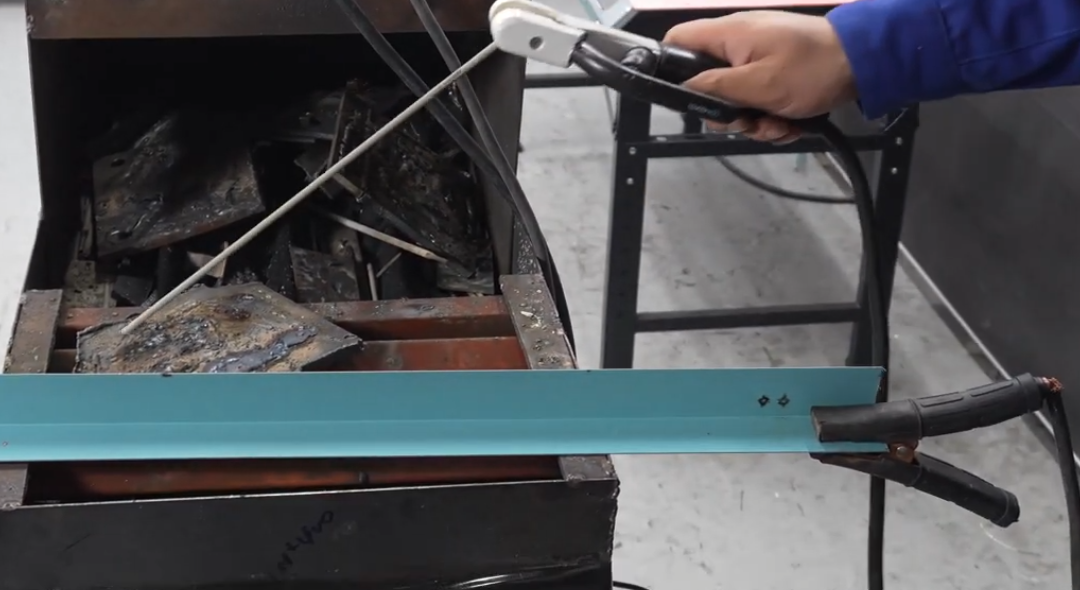

The electrode belongs in the holder. The ground clamp connects to the workpiece.
Mistake #3 – Connecting the Ground Clamp to Paint Instead of Bare Metal
This is probably one of the most common problems beginners run into.
Everything appears to be connected correctly.
The machine is turned on.
The electrode is installed properly.
But nothing happens.
Very often, the real problem is the ground clamp.
If it’s attached to painted steel, heavy rust, or a dirty surface, electricity can’t flow properly.
I remember wondering why experienced welders would spend extra time cleaning a small spot before attaching the clamp.
At first, I thought they were simply being overly careful.
Later I realized those few seconds prevented a lot of unnecessary frustration.
Whenever possible, connect the ground clamp directly to clean, bare metal.
If you need to remove a little paint or rust first, it’s well worth the effort.
📷 Photo
A clean ground connection makes a huge difference. Paint and rust reduce electrical conductivity.

Mistake #4 – Looking at the Arc Without a Welding Helmet
Almost everyone knows they should wear a welding helmet.
Unfortunately, many beginners still think,
“It’s just one quick tack weld.”
That one second is enough.
The welding arc produces extremely intense ultraviolet light.
Even a brief exposure can cause arc eye, which many welders describe as feeling like sand trapped inside both eyes.
The worst part is that the pain usually doesn’t begin immediately.
I’ve heard experienced welders say it often starts several hours later, usually when you’re trying to sleep.
That’s not a lesson anyone wants to learn the hard way.
No matter how small the job is, lower the helmet before striking the arc.
Your eyes will thank you later.
📷 Photo
Never look directly at an active welding arc without proper eye protection
.
Mistake #5 – Welding With Exposed Skin
Most beginners remember to protect their eyes.
Many forget about the rest of their body.
During hot weather, it’s tempting to roll up your sleeves or weld in a short-sleeved shirt.
I’ve seen people do it because they thought the job would only take a minute.
The problem is that welding doesn’t only produce heat.
It also produces intense ultraviolet radiation.
Even if molten metal never touches your skin, UV exposure alone can leave painful burns that feel very similar to severe sunburn.
Experienced welders wear long sleeves, gloves, and protective clothing for a reason.
It might feel uncomfortable during summer.
But after a full day around welding, you’ll understand why proper protective clothing is always worth wearing.
Part 1 Summary
Looking back, the first five mistakes all have something in common.
None of them require expensive equipment to fix.
Most of them come down to paying attention to small details before striking the first arc.
That’s something I didn’t fully appreciate until I spent more time watching experienced welders during repair projects.
In Part 2, we’ll look at another five mistakes that involve machine settings, current adjustment, cable management, and one simple trick that helps prevent electrodes from sticking to the workpiece.