
Understanding LNG Vessel Cargo Tank Design from an Engineer’s Perspective
My First Impression of an LNG Carrier (Membrane Type)
The first time I stepped onboard an LNG carrier, I expected to see something similar to a conventional oil tanker.
Instead, I found myself standing above what looked like a giant insulated box hidden inside the ship.
There were no visible cargo tanks like those found on LPG carriers.
No massive steel spheres like Moss-type vessels.
No obvious cargo structures at all.
Everything appeared surprisingly simple.
Only later did I realize that the most important part of the ship was almost completely invisible.
That hidden structure is what makes LNG transportation possible.
Why LNG Is Different from Every Other Cargo
Liquefied Natural Gas (LNG) is primarily composed of methane and is transported at approximately -162°C (-260°F) under atmospheric pressure.
Cooling natural gas to this temperature reduces its volume by nearly 600 times, making long-distance transportation economically practical.
However, this introduces an engineering challenge.
Ordinary ship steel is not designed to remain in continuous contact with cryogenic temperatures.
If LNG were placed directly inside the ship’s hull, severe thermal stress and brittle fracture could occur.
For that reason, LNG carriers are designed using an entirely different philosophy.
The cargo tank is intentionally separated from the ship’s structure.
Think of an LNG Carrier as a Giant Thermos Bottle
Whenever junior engineers ask me how an LNG carrier works, I prefer using a simple analogy.
Imagine a giant thermos bottle.
A thermos keeps hot coffee warm by preventing heat transfer.
An LNG carrier does exactly the opposite.
Its mission is to prevent external heat from entering the cargo.
Every small amount of heat entering the cargo tank creates Boil-Off Gas (BOG).
More heat means:
- Higher cargo pressure
- Increased compressor operation
- Greater cargo losses
- More complex cargo management
In other words,
the entire ship is designed around controlling heat transfer.
Understanding the Cargo Tank Structure
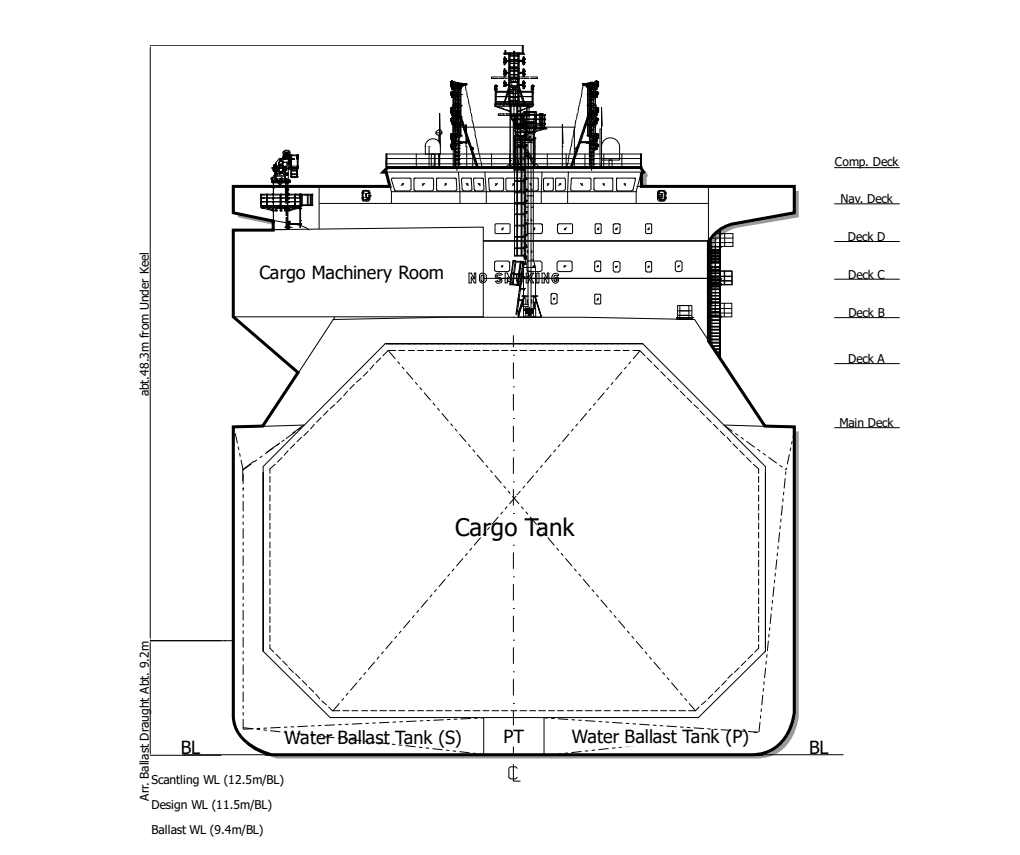
(Insert cross-section drawing here.)
One feature immediately stands out.
The cargo tank does not touch the ship’s outer hull.
Instead, several protective layers separate the cargo from seawater.
From outside to inside, the arrangement is generally:
- Outer hull
- Water ballast tank
- Inner hull structure
- Insulation system
- Primary barrier
- LNG cargo
This multiple-barrier philosophy significantly improves safety while protecting the ship’s structure from cryogenic temperatures.

Why Are Ballast Tanks Located Around the Cargo Tank?
Many cadets believe ballast tanks exist only to maintain draft and stability.
That is certainly one of their functions.
However, on LNG carriers they also provide an important protective space between seawater and the cargo containment system.
This separation minimizes thermal interaction between the cryogenic cargo and the ship’s structural steel.
From an engineering perspective, the ballast tank is not merely a stability tank.
It is part of the vessel’s overall containment philosophy.
The Cargo Machinery Room: The Hidden Heart of the Ship
Another interesting feature visible in the cross-section is the Cargo Machinery Room.
Unlike a conventional engine room, this space exists almost entirely for cargo handling.
Typical equipment includes:
- Boil-Off Gas Compressors
- Cargo Compressors
- Vapor Return Systems
- Nitrogen Generators
- Cargo Valves
- Instrumentation Panels
Although passengers never see this space, it continuously controls pressure, temperature, and cargo movement throughout the voyage.
From an engineer’s perspective, this is where the ship truly comes alive.
Every System Exists for One Purpose
One lesson I learned after spending years onboard LNG carriers is surprisingly simple.
Every major cargo system serves a single objective.
Keep LNG cold while maintaining safe cargo pressure.
The insulation reduces heat ingress.
The compressors manage Boil-Off Gas.
The instrumentation monitors pressure.
The Emergency Shutdown (ESD) system protects the cargo containment system.
Everything works together toward the same engineering goal.
Understanding this philosophy makes every other LNG system easier to understand.
What Marine Surveyors Usually Notice First
As I transition into marine surveying, I find myself looking at LNG carriers differently.
Rather than focusing only on machinery, I naturally begin asking questions such as:
- Is the insulation space monitoring system healthy?
- Are cargo compressor maintenance records consistent?
- Does the crew understand Boil-Off Gas management?
- Is cargo pressure trending normally?
- Are alarms being properly investigated?
The cargo tank itself rarely attracts attention because it quietly performs its job every second of every voyage.
Ironically, the most impressive engineering onboard is often the part nobody notices.

Final Thoughts
An LNG carrier is much more than a cargo ship carrying liquefied gas.
It is a floating cryogenic system designed to minimize heat transfer while safely transporting one of the world’s most important energy sources.
Once you understand that simple concept, every component—from insulation panels to compressors and cargo control systems—begins to make sense.
For marine engineers, cadets, and future surveyors, understanding the cargo tank is the best place to begin understanding the ship itself.
